


Five Easy Winter Edible Wild Plants
You may think that foraging is limited to the warmer months of spring and summer, but you can often find plenty of opportunities even during the coldest parts of winter. This is especially true the further south you go, and in our area of Georgia, winter foraging provides the opportunities to get and enjoy the activity with minimal issues from insects, reptiles, and the heat, which can often complicate summer foraging trips.
With the help of Dr. Mark “Merriwether” Vorderbruggen, we’ve rounded up five easy edible plants that you can find during the winter. Before heading out to forage, be sure to be well-equipped. In classes and courses with experts is the best way to learn, but you can also gain lots of knowledge and get started from a trusted text. One great example is Merriwether’s own book, Foraging: Explore Nature's Bounty and Turn Your Foraged Finds Into Flavorful Feasts, and we also like Foraging in North America Quick Guide. Both are worthy additions to your bushcraft library.
With the help of Dr. Mark “Merriwether” Vorderbruggen, we’ve rounded up five easy edible plants that you can find during the winter. Before heading out to forage, be sure to be well-equipped. In classes and courses with experts is the best way to learn, but you can also gain lots of knowledge and get started from a trusted text. One great example is Merriwether’s own book, Foraging: Explore Nature's Bounty and Turn Your Foraged Finds Into Flavorful Feasts, and we also like Foraging in North America Quick Guide. Both are worthy additions to your bushcraft library.

Beyond some field guides, you only need something to carry your foraged plants in. The WAZOO Foraging Field Bandana is a minimalist field guide featuring 12 common plants/fungi found across North America, along with uses for each. It also serves as an easy way to carry unexpected finds on the trail, and you can always have it with you. For dedicated foraging trips, the Leather Foraging Bag offers a great way to carry foraged goods hands-free. Just slip this onto your belt, and when you find something, you can pop the snap, and it expands to an 8x10-inch canvas bag.
Now let's jump into on some winter plants in Georgia that are easy to find, identify, and eat.
Dwarf Palmetto (Sabal minor)

This is a native palm tree found all across the wetter forest/marsh areas of Georgia. They appear as a cluster of large palm “fan” leaves, but the stem of each leaf goes down into the ground. There’s no noticeable trunk because the trunk, which contains an edible “heart,” is underground. A big cluster of these leaves may still reach 7’ tall and 9’ wide, and the subsurface trunk of one that size will be over 2’ tall (deep?) and 12” wide.

Like other edible palm hearts, the tasty, calorie-filled part of these palms is in the core of these leave stems. Granted, digging one up isn’t easy, but when everything is said and done, you’ll be rewarded with what is basically a long, tubular potato. This heart is slightly bitter, but it makes really good hashbrowns when shredded and then cooked in bacon grease!
Cattail Rhizomes (Typha latifolia)

Let’s keep going in this wet area to the edge of open water. There we’ll hopefully find nature’s corndog, but that’s not the part you eat. Follow a cattail’s stalks/leaves down into the muck and find a thick root (~1” in diameter) running horizontally. Gently work that out of the mud while tracing it to another cattail coming out of the water. Cut this rhizome off at the base of the second cattail, swish the freed root in the water to remove mud, then toss it up on shore. You’ve just dug up nature’s Graham cracker. Well, it still needs to be roasted, but once that’s done, the starchy, inner flesh of the rhizome tastes like Graham crackers!
Roasting is accomplished simply by setting the rhizome on hot coals until the out skin is blackened, then flipping it over to do the same to the other side. Now, peel off the blackened parts to reveal the fibrous, white core. Cut this core into bite-sized sections and pop them into your mouth. Suck the roasted starch off the fibers and then spit out the undigestible fibers when no more cracker flavor comes off them.
Wood’s Ear (Auricularia genus)
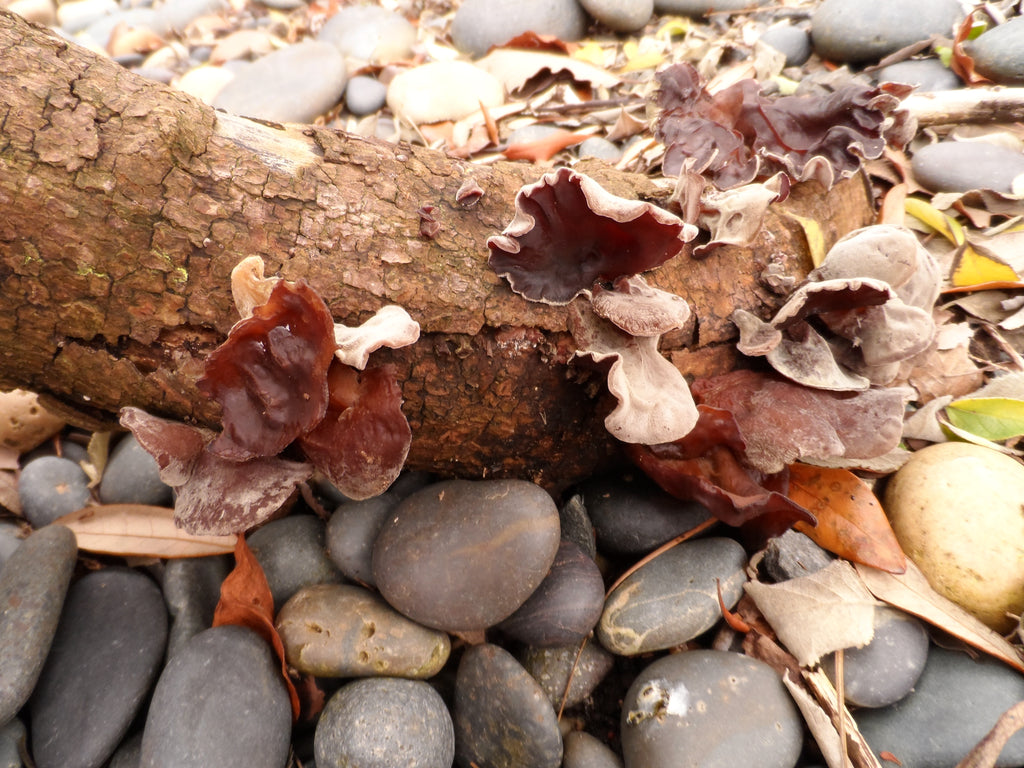
While still in this wet area, examine the dead trees, especially willow. You are seeking what looks like brown “ears” growing on the dead wood. If you are lucky, these ears will still be rubbery with smooth, brown inner skins and fuzzy grayish topsides the size and general shape of a human’s ear. However, if it hasn’t rained for a while, you may find what looks like shriveled, dried ears with black undersides and a lighter gray top. In the end, it doesn’t matter in which condition you find them because the dried ones easily rehydrate in hot water. These are the mushrooms commonly found in Chinese Hot & Sour soups. Toss them into any soup you’re making in the wild! By themselves, they are flavorless, but they absorb the soup’s seasonings and add an interesting texture to the meal.
Henbit (Lamium amplexicaule)

The member of the mint family is found in sunny fields and yards. The square stems can grow over a foot long, and scallop-shaped leaves run up it in an opposite-alternating pattern. Small, purple “dragon face” flowers grow in whorls at the tips of the non-branching stems. In spite of the plant family, henbit doesn’t have a mint flavor. To me, it tastes like fresh green beans. The stem, leaves, and flowers can be left altogether when placed on sandwiches, or they can be roughly chopped for salads or stir-fried. Finely chop it for use in sauces. Note, a small percentage of people find it has a laxative effect, so my lawyer wants me to tell y’all to try a bit at home first, just to make sure you aren’t one of those people.
Speedwell (Veronica arvensis)

Where there’s henbit, there’s likely also speedwell. At first glance, they may look similar due to the shape of the leaves. However, speedwells have much coarser hairs and 4-petaled, blue-striped flowers with white cores. Its leaves alternate along the hairy, round stem. This is another salad green/sandwich topping/pot herb plant. Try it in curry, scrambled eggs, or even sauteed. It’s often found in plentiful clusters, so go ahead and experiment with all sorts of recipes.
Of course, there are also plants I’ve written about in past articles, such as wood sorrel, wild violets, wild onions, cleavers, and many more. Don’t let “winter” stop your foraging adventures!
Go wild, eat well, carry less.
-Mark “Merriwether” Vorderbruggen, Ph.D. chemist & foraging instructor
Facebook: @medicinemanplantco and @foragingtexas
Instagram: @mmplantco and @merriwetherforager